By Dr. Dave Coyle, Clemson University
They are in GA
It was fall 2021. I was walking around our house outside Athens, GA, when I noticed a large spider web between two trees. The spider was big – about 3” across with the legs spread out – and colorful, with a bright yellow and silver abdomen. The web itself stretched nearly 10’ across. I hadn’t seen anything like that before, at least not around here. It reminded me of the large banana spiders we have down on the coast, with their huge webs, large bodies, and long legs. And then, I remembered reading about a new spider that had relatively recently been found in north Georgia called the Joro spider.
A quick image search and holy crap – there it was! I had a Joro spider in my yard for the first time. “I should tell Rick (Hoebeke, co-author of the paper first documenting this species in North America)” I thought. So I fired off an email and frankly, thought that was the end of it.
And Beyond
I noticed a couple more Joro spiders that fall, and then came 2022. To say they were everywhere would be an understatement. On the porch. On the deck. On the house. On nearly every landscape plant we had. On the powerlines along the road. On every property in the neighborhood. They were just…everywhere. And, since my job is invasive species Extension and Outreach, I figured I should get some photos and start figuring out what the heck was going on here.
My hunch was that this is something that we’d get calls about – it’s a spider, it’s big, it’s bright, and it’s invasive. And sadly, I was right. Fall 2022 was the beginning of what I like to call “Joro mania” in that every fall news outlets pick up stories about these spiders. Fast forward to summer 2024, and I’ve just gone through the third major Joro mania in as many years.
What are Joro Spiders?
So, what are Joro spiders and why does anyone care? Joro spiders (Trichonephila clavata) are native to east Asia. They were first found in north Georgia in 2014, but likely arrived as hitchhikers on shipping containers several years prior. As is common with invasive species, their populations appeared to build slowly for the first several years they were in North America, and we’re not seeing a rapid increase in their numbers.
They are currently found throughout north Georgia, the Upstate of South Carolina, parts of Tennessee and North Carolina, and also in Maryland. Of note, the disjunct population in Maryland likely occurred via human-mediated transport (i.e., they hitchhiked there on something brought up by someone). Adult females can grow to over 3 inches (or about 8 cm) across when their legs are spread, and the bodies can be upwards of 1.5 inches (about 4 cm) long. Joro spiders have bright yellow stripes on a silver or gray background, and long black legs. Eggs hatch in spring, and the spiderlings are present as early as mid-May. Females develop their characteristic coloration throughout the summer, while males remain a drab brown color and are about a quarter of her size.
Are Joro Spiders Dangerous?
So far, we have no indication these spiders are a danger to people or pets. Are they venomous, as many popular media reports suggest? Sure they are…just like all spiders, they use venom to subdue their prey. Will they bite a person? Maybe, if you agitate them enough (but honestly, what creature WOULDN’T bite if agitated?). I’ve got colleagues who have been bitten and they liken it to a cross between a mosquito bite and bee sting. Annoying? Sure. Painful? Maybe a little. But dangerous like a black widow or brown recluse bite? Not at all.
Size
There are also reports of them being giant (ok, that part is kinda true) and flying spiders. Now, while these spiders do travel through the air at times, it’s not as its portrayed. We typically see the “giant, flying spider” headline next to a picture of a mature female, insinuating that these are the ones taking to the air. Not so fast, my friend! After the eggs hatch, the tiny spiderlings (they’re about the size of a sesame seed) may crawl somewhere high and release some silk, and some of these may be carried by the wind to new places. This is called ballooning, and many spiders do this – not just Joro spiders. This ONLY happens when the spiders are tiny, and technically they aren’t even flying, as they have no control over where they go.
Where are Joro Spiders?
There is also a lot of discussion around where will they go and when. First, modeling suggests that they could survive throughout most of eastern North America. Will they get there? Maybe someday. Maybe this year, if there’s a hitchhiking event. Maybe it’ll take a decade. Who knows?
Impact
And finally, what impacts do they have? No known economic impacts at this point, and no known human or pet health impacts. We have documented reduced populations of native spiders where there are high Joro spider populations, though, and this suggests there is an ecological impact. This research is ongoing though, so stay tuned…
So, from a guy who has done dozens of interviews about the Joro spider, here are my take home messages:
- They have not been shown to be a danger to people or pets.
- Yes, they are invasive
- Yes, it appears they have negative ecological impacts
- No, they don’t fly
- Yes, they are venomous (just like all other spiders) (but also see #1)
- We have no idea if or when they’ll populate the entire East Coast
The Joro spider is the latest – and unfortunately, probably not the last – invasive species that’s taking the media by storm. And until we learn more about it, I highly advise everyone to take a measured approach when discussing this pest.
One of the most used Joro spider pictures is this adult female on Dave Coyle’s hand. Photo taken fall 2022 in Oconee Co., GA, by Dave Coyle, Clemson University.

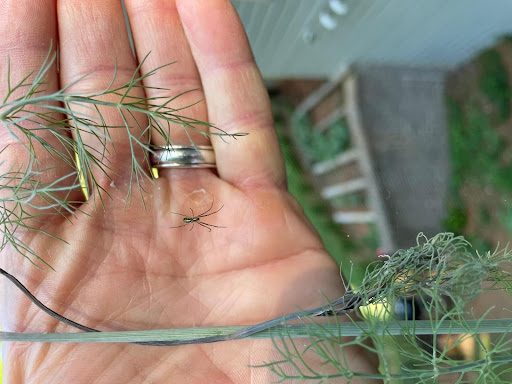
Joro spiders begin tiny, just like every other spider. This was taken in May 2023. As this article is written (June 2024) there are about 2 dozen spiders like this surrounding and on the deck at Dave’s house (and no, his wife is not amused but he keeps them there “in case he needs them for research”). Photo taken by Dave Coyle, Clemson University.
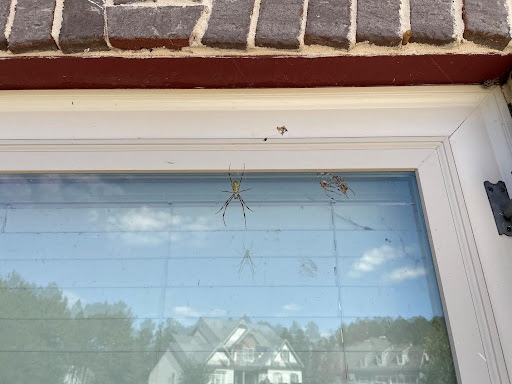
This juvenile Joro spider made a web outside one of the windows at Dave’s house. To the right of the spider, you can see shed exuviae from when it molted. This one is just starting to develop the bright yellow color seen in adult females. Photo taken by Dave Coyle, Clemson University.
About NAISMA:
The North American Invasive Species Management Association (NAISMA) is a leading organization dedicated to combating the spread of invasive species across North America. Through education, advocacy, and collaboration, NAISMA supports professionals, organizations, and communities in their efforts to manage and prevent the impact of invasive species. With a focus on innovation and partnerships, NAISMA provides resources, training, and expertise to enhance the effectiveness of invasive species management, fostering a healthier, more resilient environment. Contact us for more information.