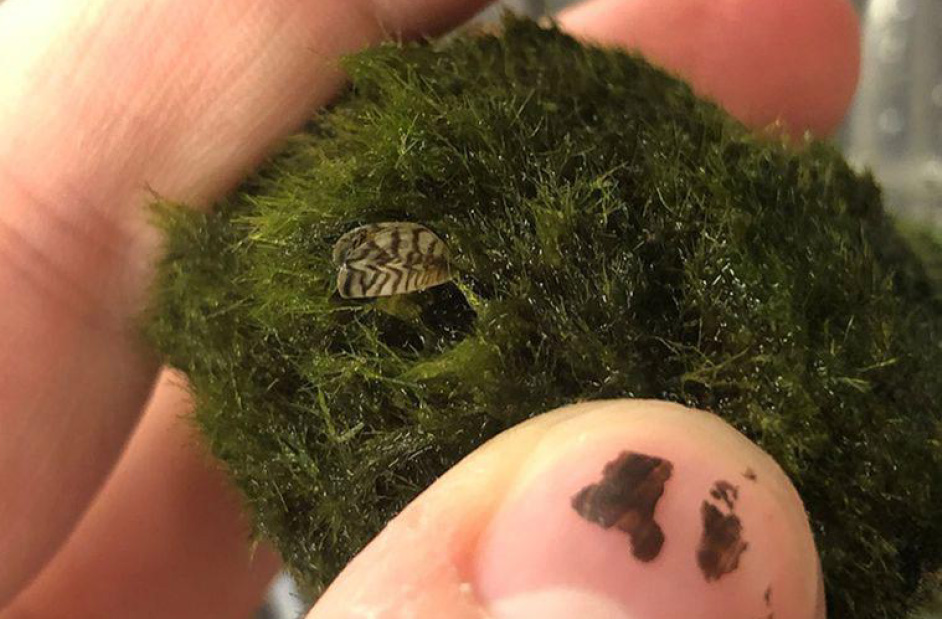
Earlier this week, U.S. Fish and Wildlife Service (USFWS) was informed of zebra mussels detected in Marimo moss balls (Aegagropila linnaei, formally Cladophora aegagropila). These moss balls were shipped from a Florida distributor to a wholesaler in Washington state. On August 8, 2024, a news release was provided by Washington Department of Fish and Wildlife outlining the events of the incident.
BackStory:
Since 2021, federal agency partners have been working together to address the importation of plant material shipments that may unintentionally have injurious species attached, or within, those shipments.
The U.S. Department of Agriculture (USDA), Animal and Plant Health Inspection Service’s Plant Protection and Quarantine program (PPQ) oversees Marimo moss ball importation into the United States. All shipments must be under a PPQ permit, have a phytosanitary certification, and are subject to inspection by PPQ. USDA’s requirements for importing moss balls into the United States can be found on the Agricultural Commodity Import Requirements (ACIR) system website.
Regulations:
The USFWS does not prohibit or otherwise regulate the import of Marimo moss balls. However,
zebra mussels are listed as injurious under Title 18 of the Lacey Act. As such, they are prohibited from importation into the United States and shipment between the continental United States, the District of Columbia, Hawaii, and the Commonwealth of Puerto Rico. It’s also prohibited to have any possession in the United States unless permitted for research or other legislatively-authorized purposes. The USFWS will enforce the injurious provision of the Lacey Act. Accordingly, PPQ will refer any shipments suspected to be contaminated with viable zebra mussels to the USFWS. Here, they are subject to enforcement actions, including but not limited to, seizure of the shipment.
Unfortunately, a shipment of suspect Marimo moss balls made it past the U.S. importation processes. We appreciate the vigilance of our State and industry partners in catching this issue early. The Service continues to support these efforts any proactive approaches to ameliorate its impact. Recommended decontamination protocols for moss balls infected with zebra mussels can be found here.
In conclusion, here is the latest news as of Mon 8/19:
Idaho confirms the presence of zebra mussels in aquarium product