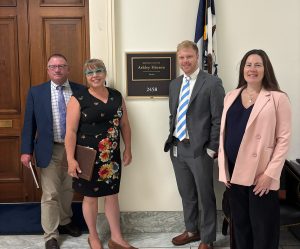
Last week, the House Committee on Natural Resources called on NAISMA to provide expert testimony on H.R. 4219 the National Wildlife Refuge System Invasive Species Strike Team Act.
In response, NAISMA put forward one of its own affiliates and a fellow member of the Invasive Species Advisory Committee (ISAC), Christy Martin of the University of Hawaii Coordinating Group on Alien Pest Species (CGAPS). Drawing on decades of experience in invasive species management, Martin delivered testimony before the Subcommittee on Water, Wildlife, and Fisheries that emphasized a strong, localized response capacity for effective invasive species control.

Martin focused on the value of “strike teams,” specialized, rapid-response units uniquely equipped to address invasive species outbreaks before they become unmanageable. These teams bring together expertise, coordination, and efficiency, allowing agencies to act decisively to protect ecosystems, wildlife, and local economies. As invasive species continue to spread across landscapes and jurisdictions, the need for this kind of agile response has only grown more urgent. She underscored that without dedicated teams in place, response efforts are often delayed, fragmented, or under-resourced, allowing invasive species to gain a foothold that becomes exponentially more difficult and expensive to manage while diminishing environmentally and culturally significant native populations.
The proposed legislation seeks to formalize and strengthen these capabilities within the National Wildlife Refuge System. By investing in strike teams, the bill aims to ensure that refuge managers are not only reacting to invasive threats, but also proactively identifying and preventing them.
Martin’s testimony included poignant personal and professional examples, and pointed to the importance of sustained funding, interagency collaboration, and leveraging existing state-level models to inform successful national-scale solutions. Her remarks resonated with the subcommittee, reinforcing the importance of sustained investment in invasive species management and prevention.
The day concluded with a brief meet-and-greet with Subcommittee Chairwoman Harriet Hageman (R-WY), offering an opportunity to further highlight the importance of science-based, field-ready approaches to invasive species management.

The full hearing is below: