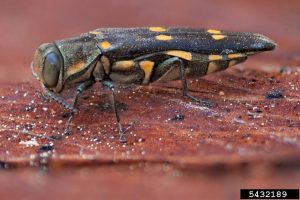
Each May, organizations across North America observe Emerald Ash Borer Awareness Week, led by the Don’t Move Firewood campaign. The week focuses on raising awareness about the devastating impacts of the emerald ash borer, one of the most destructive invasive forest insects ever introduced to North America.
As part of NAISMA’s Know Your Invasives campaign, we are highlighting emerald ash borer in May and sharing what land managers, homeowners, and outdoor recreationists can do to help slow its spread.
Meet the Emerald Ash Borer
The emerald ash borer (EAB) (Agrilus planipennis) is a small, metallic-green beetle native to parts of Asia. It was first detected in North America in 2002 near Detroit, Michigan, and Windsor, Ontario, and has since spread across much of the United States and into parts of Canada (Distribution Map).
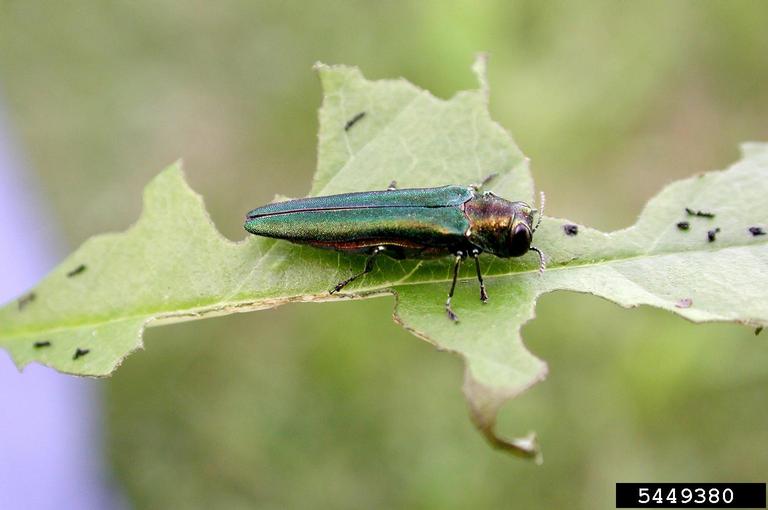
Adult beetles are slender and about 8-14 mm long (roughly ⅓-½ inch). While adults feed on ash leaves, the real damage is caused by the larvae. After eggs hatch, the larvae burrow beneath the bark of ash trees and feed on the inner bark and cambium layer. This feeding disrupts the tree’s ability to move water and nutrients, eventually killing the tree. Infested ash trees often die within two to four years.
Today, the emerald ash borer has killed hundreds of millions of ash trees across North America, dramatically altering forests, urban landscapes, and riparian ecosystems.
Why Emerald Ash Borer Matters
Ash trees (Fraxinus species) play important ecological, economic, and cultural roles across North America. They are common in forests, riparian corridors, parks, and residential landscapes, where they provide shade, wildlife habitat, and valuable ecosystem services. The loss of ash trees due to the emerald ash borer has far-reaching consequences.

Ecological impacts
Ash trees support a wide range of wildlife and contribute to forest diversity. Their loss can alter forest structure, change nutrient cycling, and create openings that allow invasive plants to establish.
Economic costs
Emerald ash borer is responsible for one of the most expensive forest insect invasions in North American history. Communities have spent billions of dollars removing hazardous trees and replacing them along streets, in parks, and on public lands.
Community and infrastructure impacts
Dead ash trees quickly become brittle and hazardous, requiring removing near roads, homes, trails, and power lines. Municipalities, homeowners, and land managers all bear these costs.
Cultural impacts
Ash wood has long been valued for tools, crafts, and traditional cultural uses. The loss of ash trees affects cultural practices and heritage for many communities, including Indigenous communities that rely on ash for basketmaking and other traditional crafts.
Signs and Symptoms of Emerald Ash Borer Infestation
Early detection can help land managers respond more quickly to new infestations.
Common signs and symptoms of emerald ash borer include:
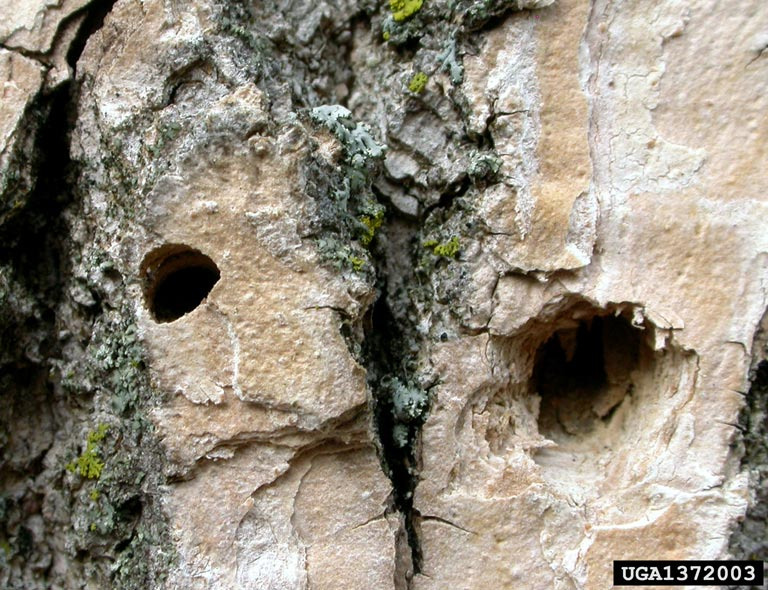
D-shaped exit holes
Adult beetles leave small D-shaped holes about ⅛ inch wide when emerging from the bark.
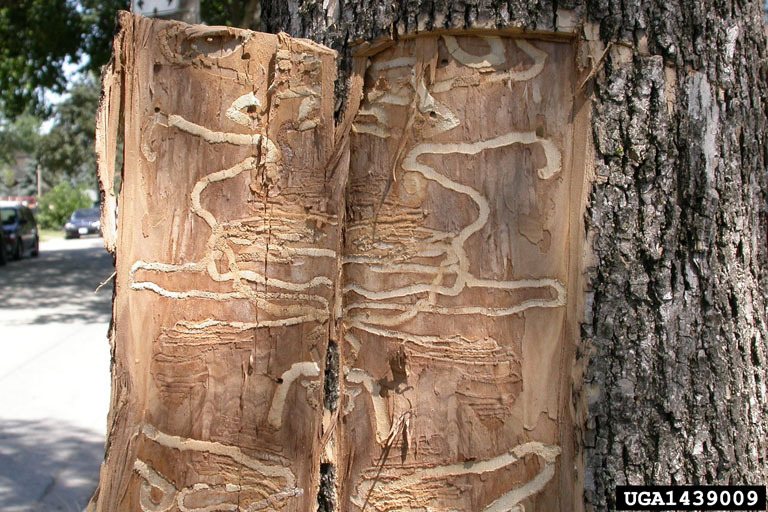
Serpentine larval galleries beneath the bark
Larvae feed under the bark, creating S-shaped tunnels packed with sawdust-like frass.
Canopy thinning and dieback
Ash trees often show thinning leaves and branch dieback, typically beginning in the upper canopy.
Epicormic sprouts
Infested trees may produce new shoots growing from the trunk or base of the tree.

Increased woodpecker activity
Woodpeckers feeding on larvae may cause noticeable bark flaking.
If you suspect emerald ash borer in your area, report observations through tools such as EDDMapS or iNaturalist, or through your local, state, provincial, or regional invasive species program.
How Emerald Ash Borer Spreads
While adult beetles can fly short distances, the insect spreads much farther and faster when people unknowingly move infested firewood.
Firewood, logs, and untreated wood products can contain hidden larvae beneath the bark. When that wood is transported to a new location, the insects can emerge and infest nearby ash trees.

Because of this risk, moving firewood long distances is strongly discouraged. A good rule of thumb is to buy or gather firewood close to where you’ll burn it. Many experts recommend sourcing firewood within about 10 miles of your destination, while distances of 50 miles or more are considered too far.
Firewood regulations can vary depending on where you are visiting, and many parks, forests, and campgrounds have specific rules about bringing or collecting firewood. Checking local guidelines before traveling can help prevent the spread of invasive insects like emerald ash borer.
The Don’t Move Firewood campaign has compiled research and guidance on safe firewood practices in their Firewood Comparison Report which compares recommendations from scientists, land managers, and outreach campaigns across North America.
Although emerald ash borer has already become widespread in many regions, new infestations are still being detected, including in parts of the Pacific Northwest where ash trees remain an important component in riparian ecosystems. In these areas, early detection and rapid response are particularly important to help slow the spread and protect remaining ash populations.
Prevention campaigns such as Don’t Move Firewood and PlayCleanGo® encourage outdoor recreationists to take simple steps that help protect forests and natural areas from invasive species.
What You Can Do to Help
Everyone who spends time outdoors can play a role in protecting forests from the emerald ash borer and other invasive species.
Simple prevention steps include:
- Don’t move firewood. Buy or gather firewood where you will burn it.
- Follow local regulations when collecting firewood.
- Use certified, heat-treated firewood when available.
- Clean gear and equipment after outdoor activities.
- Learn to recognize ash trees and signs of infestation.
- Report suspected infestations using tools such as EDDMaps, iNaturalist, or local reporting systems.
Small actions taken by many people can significantly reduce the spread of invasive pests.
Emerald Ash Borer Awareness Week
Each May, partners across North America participate in Emerald Ash Borer Awareness Week, coordinated by the Don’t Move Firewood campaign.
During the week, organizations host outreach events, share educational materials, and highlight ways communities can help prevent the spread of this destructive forest pest.
Visit Don’t Move Firewood to sign up for educational webinars and download outreach toolkits, graphics, and other outreach resources.
Know Your Invasives
The Know Your Invasives campaign highlights invasive species that threaten ecosystems, economies, and communities across North America.
Each month, NAISMA features a species to help raise awareness and share practical steps people can take to prevent their spread. The campaign also highlights a focal species each year to encourage deeper learning and coordinated outreach across partner organizations.
By learning to identify invasive species and understanding how they spread, we can all play a role in protecting the landscapes we value.