
Every month, new species are introduced to our lands and waters, new studies are published, and new methods of control are tested—with impacts varying across the map. It would be nearly impossible to stay on top of every piece of invasive species news.
However, the staff and board of the North American Invasive Species Management Association review headlines each month. This helps us stay on top of trends and further our mission to support, promote, and empower invasive species prevention and management in North America. We then share invasive species news most relevant for people who manage terrestrial and aquatic invasive species across the the United States, Canada and occasionally the world.
So, what happened this month?
- New research in integrating invasive species data sets.
- Alarm sounded over Chinese mystery seeds.
- Parasite from invasive pythons spreading among native snakes.
- This, and much more. Read on:
Success Stories: Prevention, Eradication and Restoration
Cargo Ship and Container Discovered With Potentially Dangerous Moths
United States — Read on Maritime Executive
According to U.S. Customs and Border Protection, its agriculture specialists discovered the egg mass on the exterior of a shipping container of aluminum billets from India.
Prevention, Outreach and Education
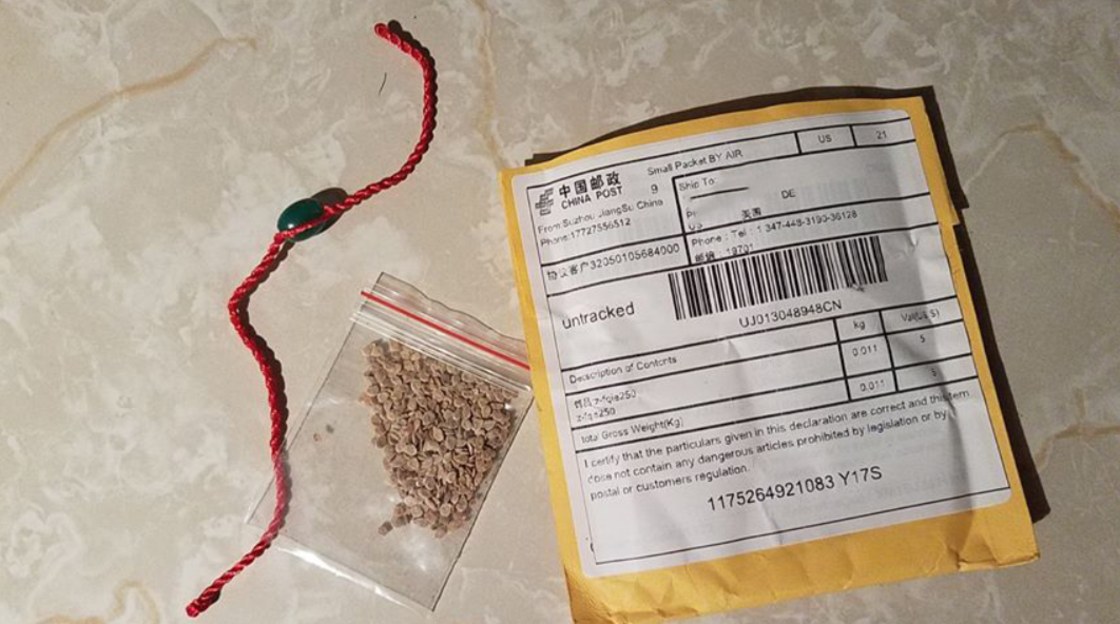
28 States Issue Warnings About Residents Receiving Unsolicited Seed Packets from China
North America — Read on NBC News
Volunteers Help Remove Invasive Wild Parsnip
New York — Read on Livingston County News
USDA Declares August ‘Tree Check Month’
New Research
A Workflow for Standardising and Integrating Alien Species Distribution Data
Is the Cure Worse Than the Disease?
Canada – Read on Facets Journal
Comparing the ecological effects of an invasive aquatic plant and the herbicide treatments used to control it
Detection, Management and Control
Invasive Hedgehogs and Ferrets Habituate to and Categorize Smells
New Zealand — Read on Ecological Society of America
Understanding predator hunting behavior and strategies is key to protecting vulnerable native species.
Invasive Species of Snail Adversely Affecting Crawfish, Rice Crops in Louisiana
Louisiana — Read on KPLC News
The Apple Snail eats at young rice plants and thrives in moist environments. Farmers say the snails are clogging their crawfish traps, forcing workers to sort through their catches so snails are not sold with the mudbugs.
Python Parasite Spreading Among Florida’s Native Snakes
Florida — Read on Tampa Bay Times
New research out of the University of Florida shows the pythons spread those Raillietiella orientalis parasites to Florida’s native snakes, and now the native snakes are spreading it amongst themselves in places where pythons have never slithered.

Policy and Rulemaking
Some Coastal Communities Say Tracking of Invasive Green Crabs Should Shift to Trapping
British Columbia — Watch on CTV News
Locals advocate for greater investment in industrial trapping, which others oppose.
A Big Rat in Congress Helped California Farmers in Their War Against Invasive Species
Washington, D.C. — Read on InsideClimate News
California Rep. Josh Harder needed a way to convince the U.S. House of Representatives to pay attention to his speech about invasive species during a meeting in February. So he brought in a hefty rat carcass and laid it on the table next to him.
Read NAISMA’s position papers here.
Conversations
Invasion Science and the Global Spread of SARS-CoV-2
Global — Read on Trends in Ecology & Evolution
Collaborations between biomedical researchers and ecologists, heretofore rare, are vital to limiting future outbreaks.
Invasive Alien Species May Soon Cause Dramatic Global Biodiversity Loss
Global — Read on Phys.org
An increase of 20 to 30 per cent of invasive non-native (alien) species would lead to dramatic future biodiversity loss worldwide.
Hidden Figures in Ecology and Evolution
United States — Read in Nature Ecology & Evolution
To do the work of justice and equity in ecology and evolution (EE) and beyond, particularly to ensure women of colour are not ignored, we need to adopt attitudes of feminist scientists and scholars who view the world with a more intersectional lens.
Want more Invasive Species News? Support our work by joining NAISMA.