Territorial behavior is not unique to humans, but our boundaries are not usually acknowledged by other species. Modern humans rarely draw land boundaries with ecologically significant or natural boundaries in mind. In our global society, these arbitrary boundaries become purely jurisdictional with the ability to move from a remote location on one side of the globe to a remote location on the other within a matter of hours rather than weeks or months. This movement accelerates the spread of invasive species among continents, countries, states and provinces, and management authorities (see our upcoming webinar, “U.S. Horizon Scan for Organisms in Trade”).
The North American Invasive Species Management Association (NAISMA), together with the Montana Invasive Species Council, hosted its 27th annual conference virtually September 27 – 30, 2021. With the overarching theme of Transboundary Cooperation, a plethora of presentations focused on the importance of and strategies used for transboundary cooperation. Examples include the welcoming keynote devoted to a case study of Waterton and Glacier National Parks, as well as breakout sessions and panel discussions highlighting the success of the Squeal on Pigs campaign and breaking down disciplinary silos to address ecosystem health. All of these discussions shared similar themes providing insight for invasive species managers at all levels.
Invasive species pose ecosystem-wide threats without regard for human-imposed boundaries. With entire ecosystems under threat from invasive species, managers can either choose to go it alone or to form partnerships that transcend jurisdictional boundaries.
Transboundary cooperation can create a continuity of invasive species management at an ecosystem-wide scale through sharing of data, resources, personnel, and expertise. This level of cooperation and communication can also move management from reactive to proactive, saving additional time and resources by reducing future management needs.
Start Transboundary Relationships Early
While working together across boundaries is important at any point, establishing lines of communication before emergent situations occur provides the ability to be proactive in management. Hopefully, starting relationships early reduces the number of emergent situations altogether.
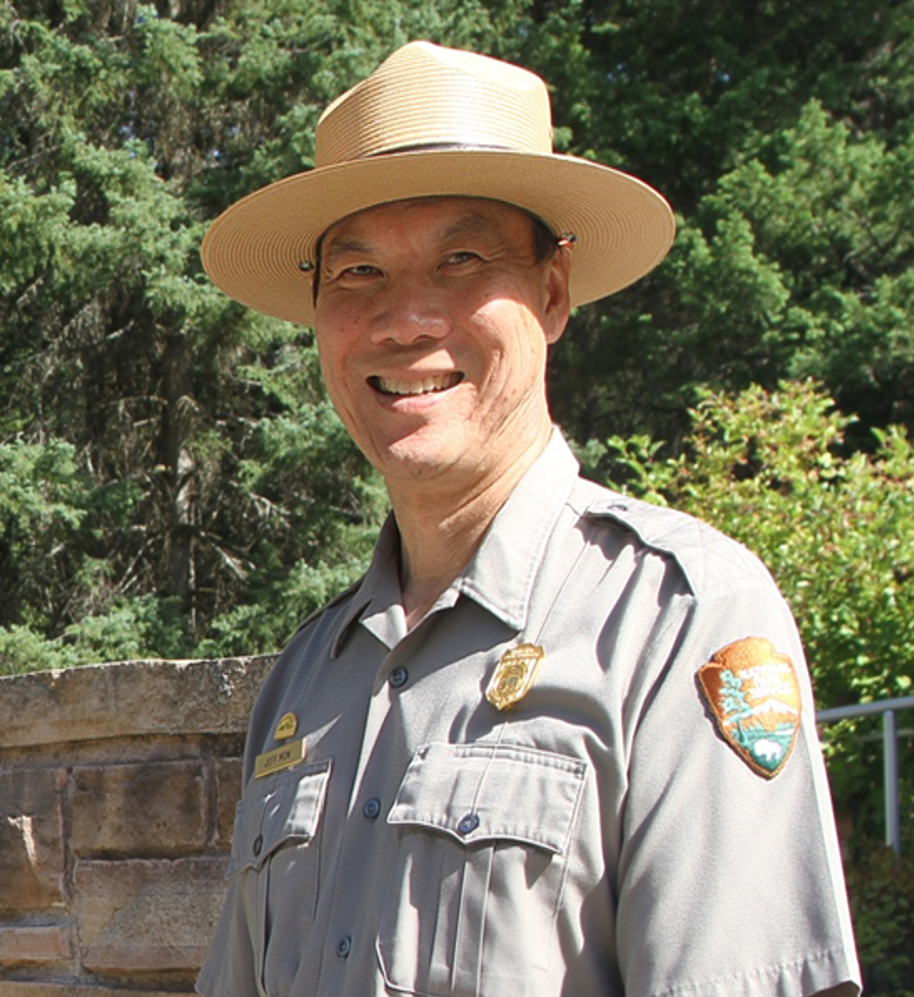
Jeff Mow, Glacier National Park superintendent 

Salman Rasheed, Waterton Lakes National Park superintendent
This is something Salman Rasheed, Waterton Lakes National Park Superintendent, and Jeff Mow, Glacier National Park Superintendent, understand well. The two parks share a border between Canada and the United States. John George “Kootenai” Brown, Superintendent of Waterton, and Albert Reynold, Ranger in Glacier, and Rotary Clubs International, worked to establish the Waterton/Glacier International Peace Park, the first of its kind, in 1932. Thanks to their proactive management, current park superintendents today work across international boundaries to protect the Crown of the Continent Ecosystem.
The superintendents do not allow the communication to stagnate. They maintain consistent and open communication. When they discovered how international regulations impeded rapid response to sharing resources for wildfire management, they worked to change the regulations because, as Superintendent Mow says, “Fire, invasive species, and climate change. They don’t wait for [international] protocols. We have to respond.”
Sharing Resources Streamlines Effort and Fosters Fresh Perspectives

Shared resources help everyone and prevent duplication of effort. No one needs to waste time (and money) trying to reinvent the wheel. In 2012, stakeholders in the Pacific Northwest launched Squeal on Pigs, an outreach campaign focused on raising awareness about invasive feral swine and their potential impacts on the region. Not only did the campaign utilize consistent imagery to reinforce the messaging throughout the region, but it created a single reporting system, the Swine Line, for all original three states (Oregon, Washington, and Idaho) further facilitating the sharing of resources and data. The Squeal on Pigs campaign allows for adaptable messaging which is imperative as it is now utilized by Montana and Alberta. Each of these jurisdictions has differing legal definitions and, in the case of Canadian provinces, associated language requirements that can all be met under this campaign.
Cooperation allows for fresh perspectives. Other invasive species managers may be able to recommend alternative techniques. Professionals in other industries can identify unforeseen weak points in planning. As Meg McEachran, Graduate Fellow and PhD candidate at University of Minnesota, has found in her research, interdisciplinary approaches and whole system perspectives can better address invasive species management as an aspect of overall ecosystem health. Through modeling of pathogen spread on baitfish in recreational angling in the lakes of Minnesota, McEachran found that sources reduction and regulations would not fully prevent the introduction of new pathogens to aquatic systems and that crossing disciplinary boundaries by implementing social science techniques and investigating theory of planned behavior is necessary to change human activities that perpetuate the spread of these pathogens.
Many invasive species managers work across boundaries and disciplinary silos in some form or fashion already, but by prioritizing cooperation with neighboring entities and adjacent fields, identifying stakeholders missing from conversations, and reestablishing lines of communication, we can be better prepared to adapt to new challenges.