Oak trees are a defining feature of many Californian landscapes. They provide food and habitat for wildlife, stabilize soils, shade waterways, and hold ecological and cultural importance for communities throughout the region. But in parts of Southern California, these foundational trees face a devastating threat from a small wood-boring beetle: the goldspotted oak borer (Agrilus auroguttatus).
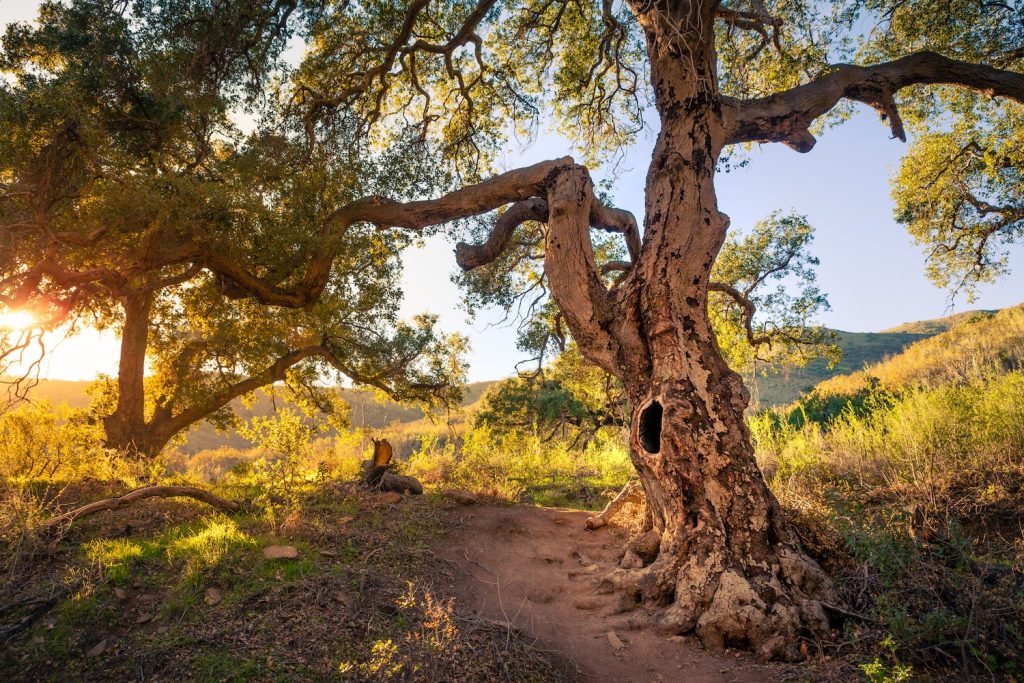
What makes the story of the goldspotted oak borer (GSOB) particularly striking is that this insect did not have to cross an ocean to become invasive. It is native to southeastern Arizona, but its arrival in Southern California, most likely through human-assisted movement of infested oak firewood, placed it among susceptible oak species that had not evolved alongside it. Since then, GSOB has caused extensive oak mortality and continues to spread into new areas in California (Coleman & Seybold, 2016; UC Riverside CISR, n.d.).
October is Firewood Month, making it an ideal time to explore the story of GSOB and how something as seemingly simple as moving a load of firewood can transport forest pests to new places.
What Is the Goldspotted Oak Borer?
The goldspotted oak borer is a wood-boring beetle in the metallic wood-borer family (Buprestidae). Adult beetles are approximately 10 millimeters (0.4 inches) long and have dark, metallic bodies with six distinctive golden-yellow spots on their wing covers, giving the insect its common name (Coleman et al., 2017; UC ANR, n.d.).
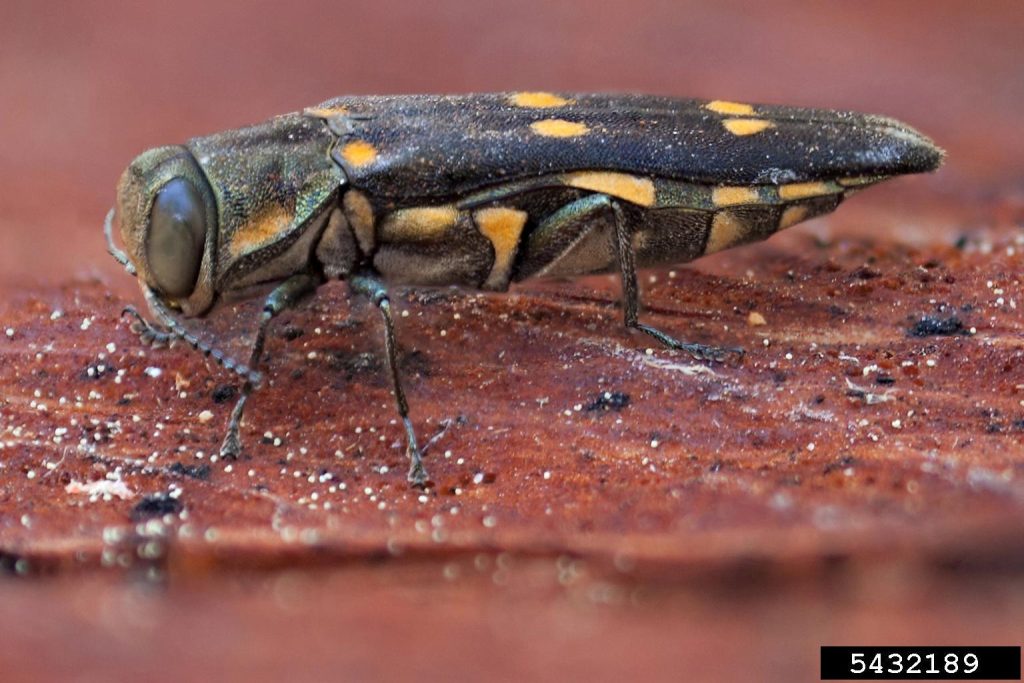
GSOB is believed to complete one generation each year in Southern California. Adult females lay eggs on the bark of host trees primarily from June through September. The eggs hatch in about two weeks, and the young larvae bore through the outer bark to feed in the phloem and outer xylem. Larvae pass through several developmental stages before moving closer to the bark surface to pupate. Adults typically emerge from mid-May through September, leaving characteristic D-shaped exit holes in the bark (UC IPM, n.d.; Coleman et al., 2017).
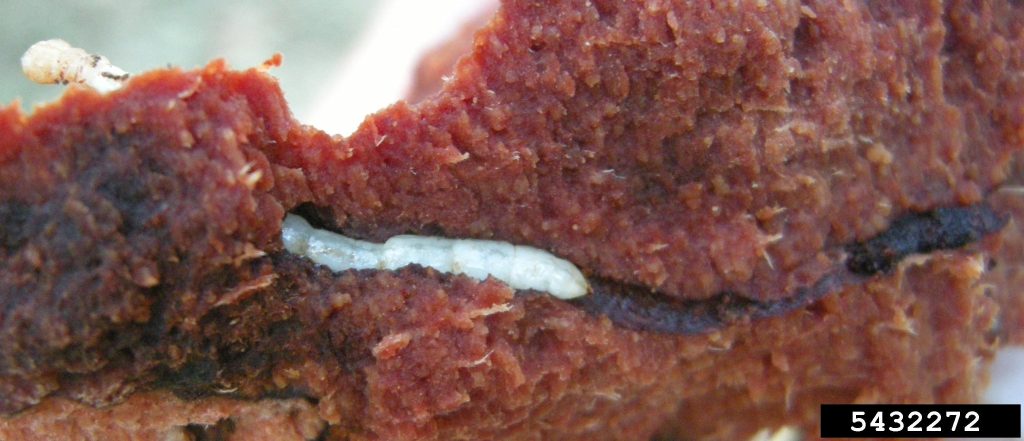
Although adults feed on oak foliage, the larvae cause the most significant damage. As they feed beneath the bark, their winding galleries disrupt the tissues that transport water and nutrients through the tree. Repeated attacks can girdle portions of the tree, eventually causing crown thinning, branch dieback, and tree death (Coleman et al., 2017; Coleman & Seybold, 2016).
In California, GSOB primarily attacks coast live oak (Quercus agrifolia) and California black oak (Quercus kelloggii). Canyon live oak (Quercus chrysolepis) can also be injured and killed, while Engelmann oak (Quercus engelmannii) is attacked only rarely. Larger, mature trees are particularly vulnerable (Coleman et al., 2017; UC IPM, n.d.).
GSOB was first collected in California in 2004, although elevated oak mortality had been observed in San Diego County as early as 2002. In 2008, researchers linked the beetle to extensive oak mortality in the region (Coleman & Seybold, 2016).
How Does the Goldspotted Oak Borer Spread?
Adult GSOB can fly and disperse naturally to nearby trees, but human movement of infested wood can carry the beetle much farther. Larvae can remain alive and continue developing beneath the bark of cut oak logs and firewood. When that wood is transported to a new location, adults may later emerge near susceptible host trees (Coleman et al., 2017; UC ANR, n.d.).
Researchers believe GSOB was introduced into Southern California in the late 1990s or early 2000s, most likely through oak firewood transported from its native range in southeastern Arizona. This human-assisted movement allowed the beetle to cross geographic barriers that would have otherwise limited its natural spread (Coleman & Seybold, 2016).
Since oak mortality in eastern San Diego County was linked to GSOB in 2008, infestations have spread throughout the county and beyond. Satellite infestations were identified in Riverside County in 2012, Orange County in 2014, Los Angeles County in 2015, and San Bernardino County beginning in 2019. Most recently, GSOB was confirmed in Ventura county in 2025. The University of California Agriculture and Natural Resources reports that these satellite infestations likely resulted from people transporting GSOB-infested firewood from known infested areas (UC ANR, n.d.).
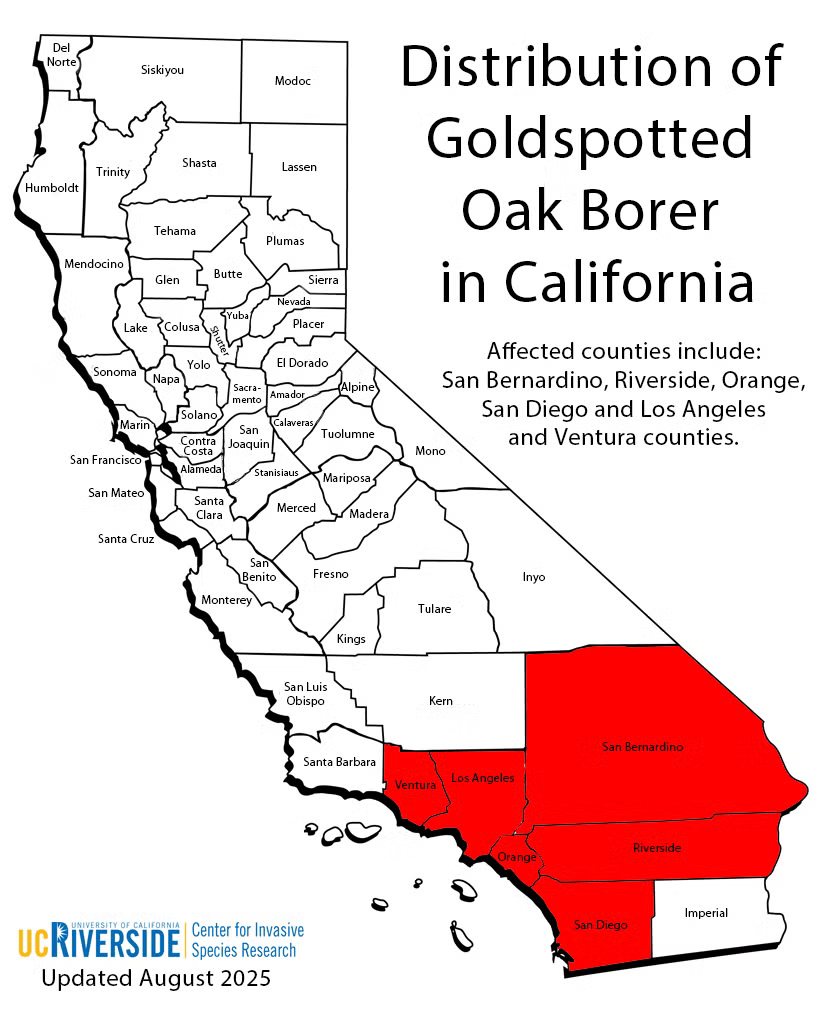
That history makes GSOB a particularly powerful example of how human-assisted movement can accelerate the spread of invasive species. While an adult beetle may naturally fly to a nearby tree, moving infested firewood can give it a ride to an entirely new forest.
How to Recognize an Infestation
Early detection is especially important when GSOB appears outside areas where it is already established. Signs associated with infestation include:
- Progressive thinning and dieback of the tree canopy
- Dark or black staining on the bark
- Bark injury caused by woodpeckers feeding on larvae and pupae
- D-shaped adult emergence holes, approximately 1/8 inch (3–4 millimeters) wide
- Larvae and winding feeding galleries beneath the bark
Signs of GSOB infestation may not be obvious during the early stages of injury. Because crown thinning, bark staining, and other symptoms can also result from drought, disease, or other insects, multiple indicators should be considered when evaluating a tree. D-shaped emergence holes are one of the most definitive external signs of GSOB infestation (UC ANR, n.d.; UC IPM, n.d.).


Suspected infestations, particularly those outside known infested areas, should be reported to appropriate local or state forestry or agricultural authorities.
What Are the Impacts?
The consequences of GSOB extend far beyond individual trees. The University of California Riverside Center for Invasive Species Research reports that GSOB has contributed to the mortality of more than 80,000 trees in Southern California (UC Riverside CISR, n.d.).
The beetle’s impacts in California differ dramatically from those observed within its native range in southeastern Arizona, where GSOB are not considered a major pest. Researchers suggest that natural enemies and resistance among oak species that evolved alongside the beetle may help limit its impacts there (UC Riverside CISR, n.d.).
Oaks are foundational components of Southern California woodlands, providing food, shelter, nesting sites, and other resources for a wide range of wildlife. The loss of mature trees can reduce habitat and food resources, alter shade in riparian areas, and change the structure of oak woodland ecosystems (Coleman & Seybold, 2016).

Dead and declining trees can also create hazards near homes, roads, campgrounds, and other developed areas. Research has documented changes in fuel loading associated with severe, long-term GSOB infestation, adding another consideration for land managers in fire-prone Southern California landscapes (Coleman, 2015).
The impacts are also cultural. Oaks are deeply important to many Indigenous communities in Southern California, and the loss of mature trees affects culturally significant landscapes and resources. For the La Jolla Band of Luiseño Indians, responding to GSOB has included research, forest management, workforce development, tree propagation, and efforts to integrate Indigenous knowledge and contemporary management practices (Tamm, 2024).
How Is the Goldspotted Oak Borer Managed?
Once GSOB becomes established, management can be challenging. Current strategies focus on limiting its spread, detecting infestations early, protecting healthy or high-value trees, managing infested wood, and reducing the risk that beetles will reach additional susceptible oaks (Coleman et al., 2017; UC IPM, n.d.).
Management approaches depend on the condition of individual trees and the surrounding landscape. Monitoring can help identify new infestations and determine the severity of damage. Severely infested trees may need to be removed when they pose safety hazards or are unlikely to survive. Cut wood from infested trees must also be managed carefully because GSOB can continue developing and emerge from firewood-sized pieces of oak (UC ANR, n.d.; UC IPM, n.d.).
Treatment options may be appropriate for some healthy, high-value trees, while other situations require broader landscape-level strategies. Integrated approaches that combine monitoring, prevention, appropriate treatment, sanitation, and careful management of infested material can help reduce impacts and slow further spread (Coleman et al., 2017; UC IPM, n.d.). Any pesticide treatment should be selected and applied according to the product label, applicable regulations, and site-specific management objectives..
Exploring Tribally Led Management Approaches
Researchers and land managers are also investigating new approaches to GSOB management.
Joelene Tamm, Natural Resources Director for the La Jolla Band of Luiseño Indians and a member of the Squaxin Island Tribe, has studied the potential for cultural burning and Traditional Ecological Knowledge to inform landscape-level GSOB management. Working with the La Jolla Band of Luiseño Indians and research partners, her work has examined heat treatment of infested wood, pile burning, and prescribed fire as potential tools for reducing GSOB survival and developing management practices that support healthier oak woodlands (Tamm, 2024).
This Tribally led research provides an important example of how Indigenous knowledge and contemporary scientific research can inform management of a complex invasive species problem.
Readers can explore Tamm’s work in her Tribally Led Goldspotted Oak Borer Research StoryMap.
What Can We Do? Preventing the Spread During Firewood Month
October is Firewood Month, an annual opportunity to raise awareness about one of the most important pathways for the movement of invasive forest insects and diseases.
Firewood may look harmless while harboring insects, larvae, eggs, or pathogens beneath the bark or within the wood. Moving it long distances can give these organisms access to forests they could never reach on their own.
The Don’t Move Firewood campaign recommends several simple alternatives:
- Buy firewood where you will burn it.
- Purchase certified heat-treated firewood.
- Gather firewood on site when permitted.
- Check and follow firewood regulations and recommendations for the places you are visiting.
For GSOB specifically, infested oak wood should not be moved out of local infested areas. UC Agriculture and Natural Resources identifies transporting infested firewood as likely the most significant pathway for introducing GSOB into uninfested areas (UC ANR, n.d.).

The journey of the goldspotted oak borer from southeastern Arizona to Southern California shows why these actions matter. A species does not need to arrive from another continent to become invasive. Human activities can move organisms beyond the geographic and ecological barriers that historically limited their distributions, introducing them into ecosystems that did not evolve alongside them.
By keeping firewood local, learning to recognize signs of forest pests, reporting suspected new infestations, and following local guidance for handling potentially infested wood, we can help reduce the risk of creating the next introduction.
Learn more about Firewood Month and safer firewood choices through the Don’t Move Firewood campaign.
For those interested in learning more about forest insects, diseases, pathways, early detection, and management, the NAISMA Academy Forest Pest and Pathogen Short Course provides a self-paced introduction to forest pest and pathogen prevention and management. The course includes GSOB as a case study connecting pathways, prevention, and real-world invasive species management.
References
Coleman, T. W. 2015. Influence of the Invasive Goldspotted Oak Borer on Fuel Loading in Southern California. In R. B. Standiford & K. L. Purcell (Tech. Coords.), Proceedings of the Seventh California Oak Symposium: Managing Oak Woodlands in a Dynamic World (pp. 339–343). General Technical Report PSW-GTR-251. USDA Forest Service, Pacific Southwest Research Station.
Coleman, T. W., Jones, M. I., Smith, S. L., Venette, R. C., Flint, M. L., & Seybold, S. J. 2017. Goldspotted Oak Borer. Forest Insect & Disease Leaflet 183, revised August 2017. USDA Forest Service.
Coleman, T. W., & Seybold, S. J. 2016. Goldspotted oak borer in California: Invasion history, biology, impact, management, and implications for Mediterranean forests worldwide. In T. D. Paine & F. Lieutier (Eds.), Insects and Diseases of Mediterranean Forest Systems (pp. 663–697). Springer International Publishing.
Hishinuma, S., Coleman, T. W., Flint, M. L., & Seybold, S. J. 2011. Goldspotted Oak Borer: Field Identification Guide. University of California Agriculture and Natural Resources, Statewide Integrated Pest Management Program. 6 pp.
Tamm, J. 2024. Tribally Led Goldspotted Oak Borer Research. ArcGIS StoryMaps. January 28, 2024.
University of California Agriculture and Natural Resources (UC ANR). n.d. Goldspotted Oak Borer: Distribution Maps.
University of California Agriculture and Natural Resources (UC ANR). n.d. Goldspotted Oak Borer.
University of California Statewide Integrated Pest Management Program (UC IPM). n.d. Goldspotted Oak Borer. University of California Agriculture and Natural Resources.
University of California, Riverside, Center for Invasive Species Research (CISR). n.d. The Goldspotted Oak Borer.