
February 17, 2027 @ 10:00 am – 11:00 am CST
To date, environmental conditions have been enough to act as an effective barrier to prevent non-indigenous species from arriving and establishing in Arctic Canada. However, rapidly changing climatic conditions are creating more suitable habitats for non-indigenous species to potentially establish and become invasive. Concurrently, shipping traffic in parts of Arctic Canada has increased by over 250% since 1990, providing an effective vector for transporting non-indigenous species to the region. Arctic Canada has been historically undersampled, so Arctic biota inventories are incomplete, hampering efforts to establish if a species is new to the region (and potentially invasive) or newly discovered. In this study, we utilize environmental DNA (eDNA) metabarcoding and ships of opportunity to assess eukaryotic community composition and potential invasives along one of the busiest shipping routes, the Northwest Passage. One liter seawater samples were collected in triplicate at 27 locations, targeting touristic hotspots frequently visited by passenger vessels. Eukaryotic DNA was amplified from the 18S rRNA V9 and COI regions, resulting in 126 unique Amplicon Sequence Variants (ASVs) detected with COI and 391 ASVs with 18S, providing an important snapshot of current community composition. Copepods, dinoflagellates, and diatoms were the most abundant taxonomic groups, correlating well with previous net sampler surveys, validating the efficacy of eDNA for biodiversity surveillance. We also report the first detections of a prolific invasive species, the bay barnacle (Amphibalanus improvisus), in Arctic Canada. Further work is currently in progress to establish whether these detections represent transient barnacle larvae or sessile adults capable of recruiting and reproducing. Our study demonstrates the utility of eDNA for the detection of non-indigenous species in a data-poor area, which, if combined with citizen science initiatives and local communities, could provide a vital monitoring tool for the detection of new invasives in this rapidly changing area.
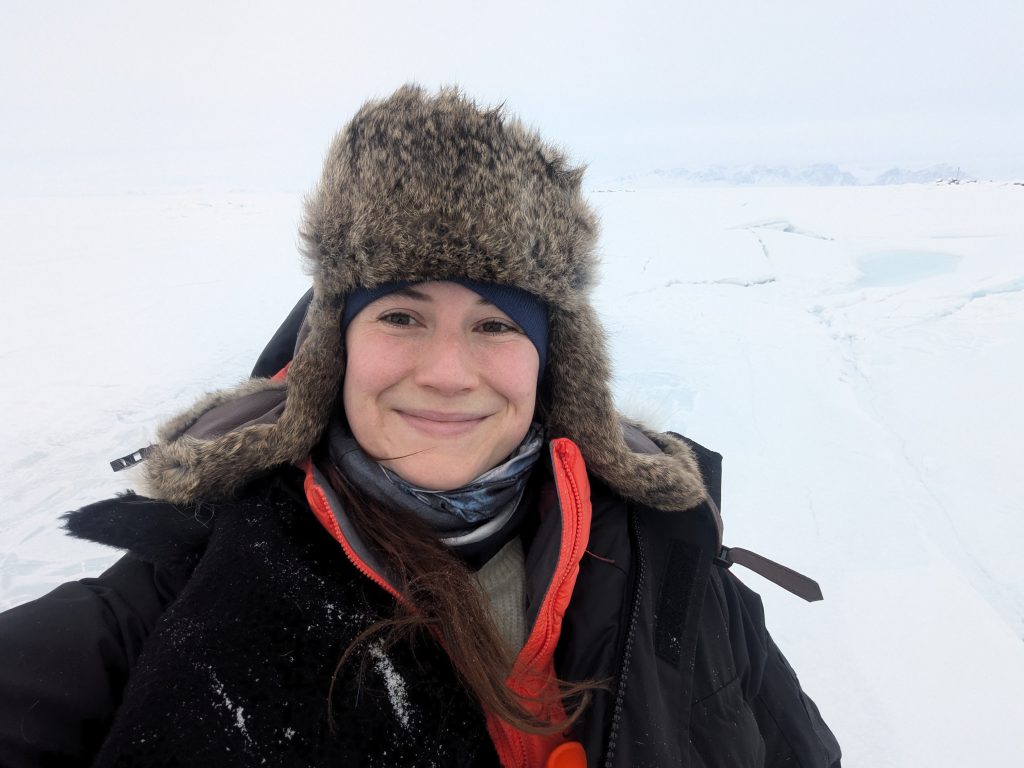
Elizabeth Boyse, Molecular Ecology Research Fellow, University College London (UCL)
Betty Boyse is a molecular ecologist specializing in the use of environmental DNA (eDNA) technologies to support biodiversity monitoring and conservation management. She is currently a postdoctoral research fellow in Joanne Littlefair’s lab at UCL, where she is investigating the potential of airborne eDNA for terrestrial biodiversity. In particular, she is working on samples collected from the Swiss air quality monitoring network to investigate how terrestrial communities have changed over the past 20 years in response to environmental factors and human impacts.
Previously, she worked as a postdoctoral research associate at the British Antarctic Survey, where she collected marine eDNA samples along the Northwest Passage in Arctic Canada to detect invasive species that may have arrived as a result of increasing shipping traffic. She also provided a current baseline of community composition, facilitating the detection of new arrivals in the future.
For her PhD at the University of Leeds, she investigated the use of marine eDNA to simultaneously detect marine mammals and their key prey species, improving understanding of fine-scale habitat use. She also explored the reconstruction of ecosystem networks (food webs and co-occurrence networks) from eDNA data across the tree of life (e.g. from plankton to whales).