

July 17, 2024 @ 1:00 pm – 2:00 pm CDT
Speaker: Dr. Heather L. Spalding, Associate Professor, College of Charleston
Co-Authors: Taylor Williams, Brian Hauk, Andrea Kealoha, and Randall Kosaki.
The Papahānaumokuākea Marine National Monument is one of the largest marine conservation areas in the world and supports a high diversity and abundance of native marine flora and fauna. In 2019, a new cryptogenic red alga, Chondria tumulosa, was observed forming dense mats that rapidly overgrew native corals and algae at Manawai (Pearl and Hermes Atoll). By 2023, up to 40% of sites surveyed at Manawai contained Chondria mats in the lagoon, back reef, and fore reef from 1 to 21 m depths. Chondria percent cover was up to 95% over a 25 x 1 m area, with a canopy height of 21 cm. Stable isotope analyses of Chondria tissue δ15N ranged from 2.2-3.4‰, suggesting its distribution was not influenced by anthropogenic or shore-based processes (like seabird guano). However, the %N in algal tissue ranged from 0.95-2.75%, suggesting enrichment by other processes is occurring. Additional studies on this alga’s ecophysiology and microbiome are needed to determine its mechanism(s) of success in oligotrophic waters with intact top down processes. This alga poses a serious threat to coral reefs in the Pacific because of its mat-forming morphology, fragmentation, attachment to nets and other algae, and high abundance in nearly pristine, nutrient-poor environments.
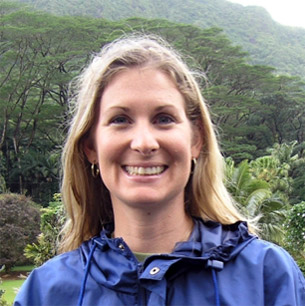
Dr. Heather Spalding grew up on a small cattle farm in Kentucky but was usually found underwater in the murky depths of the farm pond exploring the mud and “moss”. She received her undergraduate degree in marine science from Southampton College at Long Island University under the tutelage of Dr. Larry Liddle. This led to an internship on kelp forest ecology at Moss Landing Marine Labs (MLML) with Dr. Mike Foster, where she discovered that being comfortable underwater in low light was a useful skill for a phycologist. After completing her master’s degree in marine science at MLML, she was lured to the University of Hawaiʻi to study macroalgae with Dr. Isabella Abbott and Dr. Celia Smith for her doctoral degree in marine botany, with an emphasis on ecology, evolution, and conservation biology. This research led to studies on mesophotic coral ecosystems in the Hawaiian Archipelago using technical diving and submersibles, and the discovery of new macroalgal species and deep water coral reefs. After several years of post-doctoral fellowships at the University of Hawaiʻi at Mānoa and the Papahānaumokuākea Marine National Monument on algal biodiversity and ecophysiology, Dr. Spalding accepted a tenure-track position in marine biology at the College of Charleston in 2019. She is now an Associate Professor at the College of Charleston and has published over 50 peer-reviewed papers and 10 book chapters on macroalgae and corals.