August is a great time to pay closer attention to the trees in your neighborhood, parks, forests, and favorite recreation areas. During late summer, many forest pests and diseases become easier to recognize, making it an excellent opportunity to look for anything unusual and report potential problems to local forest health professionals. One of the most significant emerging threats to North America’s forests is beech leaf disease (BLD), a destructive disease affecting both native American beech (Fagus grandifolia) and ornamental European beech (Fagus sylvatica). Since its discovery in northeastern Ohio in 2012, BLD has spread rapidly across much of the northeastern and midwestern United States and into several Canadian provinces (Burke et al., 2020; USDA National Invasive Species Information Center).
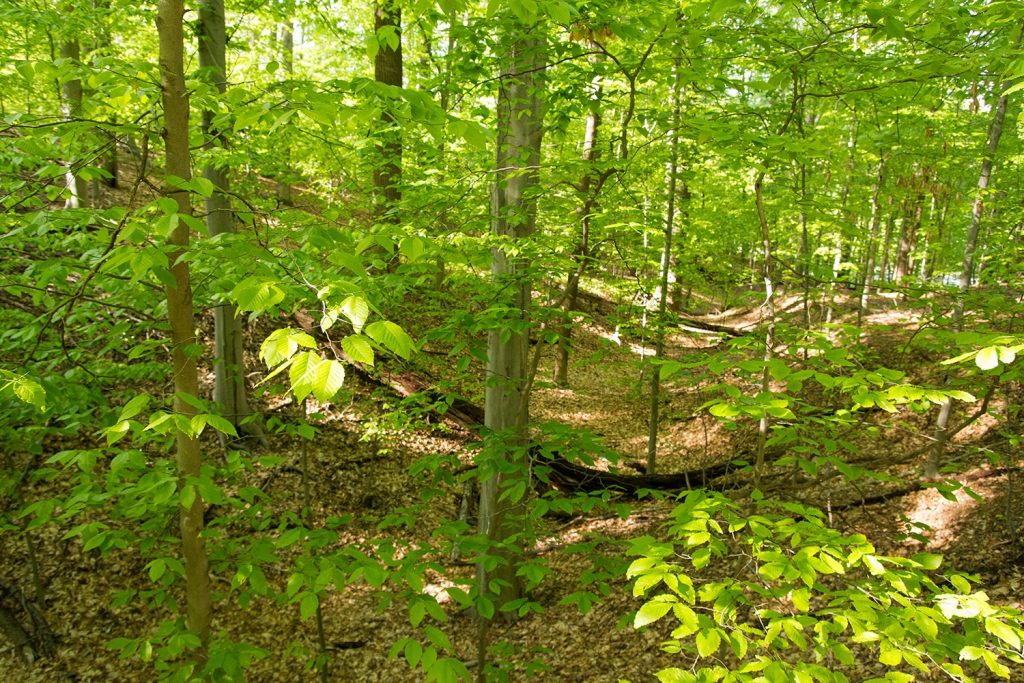
American beech is a foundation species throughout eastern forests. Healthy beech trees provide food, shelter, and nesting habitat for wildlife, help regulate forest microclimates, stabilize soils, and store carbon. The loss of these trees has ecological consequences that extend far beyond individual forests (USDA ARS; USDA National Invasive Species Information Center).
What is Beech Leaf Disease?
Beech leaf disease is associated with the microscopic foliar nematode Litylenchus crenatae mccannii, first described from affected American beech trees in North America by Carta et al. (2020). These microscopic roundworms invade developing buds and leaves, disrupting normal leaf development, reducing photosynthesis, and weakening trees over time (Carta et al., 2020; Reed et al., 2020).
Although researchers continue to investigate the complete disease process, evidence strongly links this nematode with the characteristic symptoms observed throughout affected forests. Trees of every age class can become infected, although seedlings and saplings often decline more quickly than mature trees (USDA Forest Service).
How to Identify Beech Leaf Disease
Learning to identify symptoms is one of the most effective ways to support early detection.
- Dark green banding between leaf veins, often easiest to see when leaves are held toward the light.
- Thickened, leathery leaves.
- Curling, puckering, or distorted foliage.
- Reduced bud production and sparse foliage.
- Progressive canopy thinning.
- Premature leaf drop.
- Branch dieback.
- Eventual tree mortality in severe infections.
Many symptoms become more obvious from late spring through summer, making August an excellent time for monitoring (USDA Forest Service; Michigan Invasive Species Program).

How Does Beech Leaf Disease Spread?
Scientists continue to study how beech leaf disease spreads. Research indicates the nematode survives within buds and leaves, while movement of infected nursery stock appears to be an important pathway. Wind, rain splash, wildlife, and human movement of infected plant material may also contribute, although these pathways continue to be investigated (Reed et al., 2020; USDA Agricultural Research Service).
Because important questions remain, limiting unnecessary movement of plant material remains one of the best preventative actions.
Where Has Beech Leaf Disease Been Found?
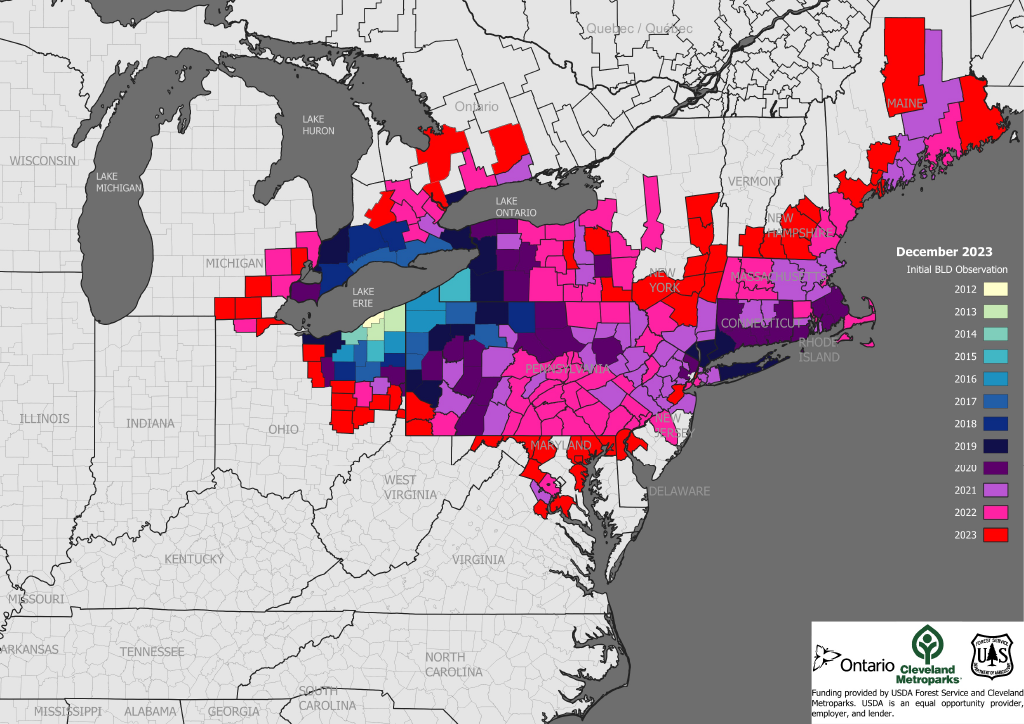
Confirmed detections now occur across numerous northeastern and midwestern U.S. states and several Canadian provinces, with new detections reported almost every year. Because the known range continues to expand, anyone living within the native range of American beech should remain vigilant (USDA National Invasive Species Information Center). The USDA Forest Service’s county-level distribution map provides an overview of where beech leaf disease has been confirmed in the United States and Canada through 2024.
Can Beech Leaf Disease Be Treated?
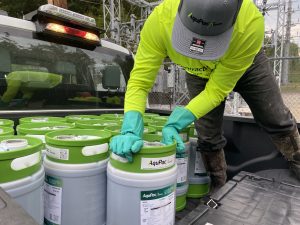
There is currently no practical cure for natural forests. However, researchers continue to evaluate management options for high-value landscape trees, including systemic treatments and other approaches that target the disease-causing nematode. While some treatments have shown promise for protecting individual trees, additional research is needed to better understand their long-term effectiveness and appropriate use (Epiphan et al., 2025). Scientists are also studying genetic resistance within American beech populations and improving methods for monitoring and understanding the disease (USDA Forest Service; McIntire et al., 2026).
Recent research also shows infected trees experience reduced growth and depleted carbohydrate reserves, helping explain why repeated infections eventually lead to decline and mortality (McIntire et al., 2026).
What You Can Do
Although there is currently no practical treatment for beech leaf disease in natural forests, early detection remains one of the most important ways the public can help protect North America’s beech forests. Observations from landowners, foresters, arborists, and outdoor recreationists help researchers track the disease’s spread, identify potentially resistant trees, and guide future management and research efforts.
You can help by:
- Learn to identify American beech by its smooth gray bark, long pointed buds, and simple oval leaves.
- Watch for symptoms of beech leaf disease, including dark green banding between leaf veins, thickened or distorted leaves, canopy thinning, and branch dieback.
- Report suspected cases to your state or provincial forest health program, Cooperative Extension office, or other local forest health specialists.
- Document healthy and affected beech trees using the TreeSnap app to support research on disease distribution and potential genetic resistance.
- Avoid moving beech seedlings or other live plant material from areas where the disease is known to occur unless it complies with local regulations.
- Use locally sourced or certified firewood to reduce the risk of spreading forest pests and diseases to new areas.
Every observation helps improve our understanding of beech leaf disease. Whether you are hiking a favorite trail, visiting a local park, or walking through your neighborhood this August, take a moment to look up. Recognizing the symptoms of beech leaf disease and sharing your observations can help researchers and forest managers better protect one of North America’s most important native tree species.
References
- Burke, D. J., Hoke, A. J., & Koch, J. (2020). The emergence of beech leaf disease in Ohio: Probing the plant microbiome in search of the cause. Forest Pathology, 50(2), e12579.
- Carta, L. K., Handoo, Z. A., Li, S., et al. (2020). Beech leaf disease symptoms caused by newly recognized nematode subspecies Litylenchus crenatae subsp. mccannii. Forest Pathology, 50(2), e12580.
- Epiphan, J., Buckley, R., Waller, T., & Dvorin, R. (2025). Beech Leaf Disease & Management Options (Cooperative Extension Bulletin E376). Rutgers Cooperative Extension, Rutgers, The State University of New Jersey.
- McIntire, C. D., Loyd, A. L., Rigsby, C. M., et al. (2026). Beech Leaf Disease Impairs Growth and Carbohydrate Storage in Fagus grandifolia. Forest Pathology.
- Reed, S. E., Greifenhagen, S., Yu, Q., et al. (2020). Foliar nematode population dynamics in beech leaf disease-affected trees. Forest Pathology, 50(3), e12599.
- USDA Agricultural Research Service. What’s Killing Beech Trees?
- USDA Forest Service. Beech Leaf Disease research publications and fact sheets.
- USDA National Invasive Species Information Center. Beech Leaf Disease.