At first glance, a nutria (Myocastor coypus) might look like an oversized muskrat or even a small beaver. With its coarse brown fur, prominent orange teeth, partially webbed hind feet, this semi-aquatic rodent is well adapted to life in and around wetlands.
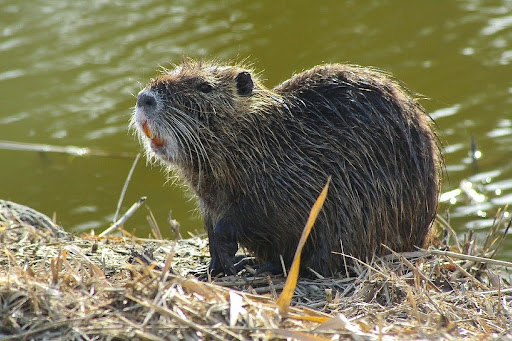
But nutria can dramatically transform the habitats they occupy.
Originally brought to North America for the fur trade, nutria escaped or were released into the wild and established populations in wetlands across parts of the United States. Their feeding and burrowing can damage wetland vegetation, accelerate erosion, harm agricultural crops, and weaken levees and other infrastructure. In heavily affected marshes, nutria can contribute to the conversion of vegetated wetlands into open water (USDA APHIS, 2025).
What Is a Nutria?
Nutria (Myocastor coypus) are large, herbivorous rodents native to South America. Adults typically weigh between 15 and 20 pounds, although some individuals can exceed 25 pounds. They are strong swimmers and spend much of their time in and around rivers, marshes, swamps, ponds, canals, and other aquatic habitats.
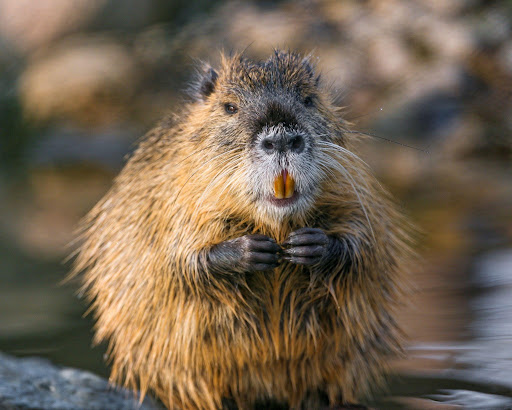
Nutria are often mistaken for native muskrats or beavers, but several characteristics help distinguish them:
- Large, bright orange incisors
- Prominent white whiskers
- Long, round, sparsely haired tail, rather than the broad, flattened tail of a beaver
- Partially webbed hind feet
- A body approximately two feet long, excluding the tail
Nutria are also prolific breeders. They can reach sexual maturity within several months and may produce multiple litters in a year. In Virginia, wildlife managers report that nutria may produce up to three litters annually, typically with four to five young per litter (Virginia Department of Wildlife Resources, 2021).
Their ability to reproduce quickly, disperse through waterways, and feed on a wide variety of vegetation has helped nutria establish populations far beyond their native range.
From Fur Farms to the Wild
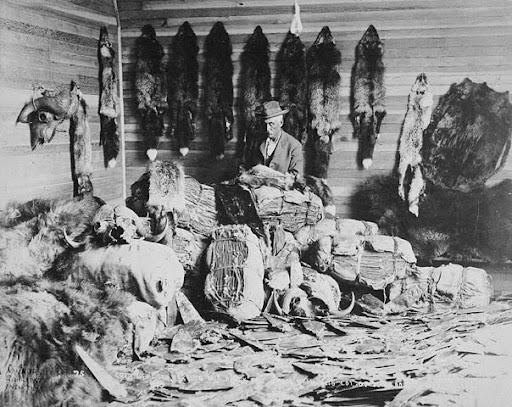
The fur trade had already shaped North American economies and wildlife populations for generations when entrepreneurs began looking to nutria as another potentially valuable fur-bearing species.
The first documented nutria brought to the United States arrived in California in 1899, but commercial nutria farming expanded much more widely during the 1930s. Fur farms were established in states including Washington, Oregon, Michigan, Louisiana, Ohio, New Mexico, and Utah as producers sought to raise nutria for their pelts (Evans, 1970).
The industry did not last. Low fur prices, poor reproduction on some farms, competition from other furs, and disruptions associated with World War II contributed to the collapse of many nutria operations. Animals escaped from inadequate enclosures or during storms and floods, while others were deliberately released when farms closed. These releases and escapes helped establish wild populations in multiple parts of the country (Evans, 1970).
Louisiana became particularly important in the history of nutria in the United States. Nutria were imported there for fur farming during the 1930s and subsequently became established in the state’s coastal marshes. For decades, commercial trapping helped suppress populations, but as demand and prices for fur declined, trapping activity also decreased and nutria populations increased (Louisiana Department of Wildlife and Fisheries, n.d.).
A similar story unfolded elsewhere. Nutria introduced to Maryland’s Eastern Shore for the fur market in the 1940s eventually spread across the Delmarava Peninsula. California, meanwhile, once considered nutria eradicated from the wild during the 1970s, discovered a reproducing population in the San Joaquin Valley in 2017 (U.S. Fish and Wildlife Service, 2022; University of California Agriculture and Natural Resources, 2025).
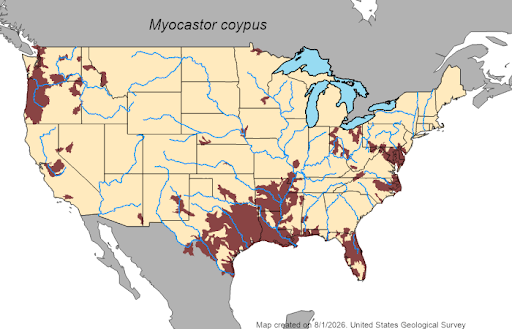
Today, nutria populations occur across portions of the Gulf Coast, Pacific Northwest, California, and other areas of the United States, although their distribution continues to change as populations expand in some areas and intensive eradication programs eliminate them from others (U.S. Geological Survey, n.d.).
Impacts of Nutria
Nutria can affect natural ecosystems, agriculture, infrastructure, and, in some circumstances, human and animal health. Their greatest impacts, however, are often concentrated in wetlands.
Eating a Wetland from the Roots Up
Nutria are voracious herbivores. An individual may consume vegetation equal to approximately 25 percent of its body weight each day (Virginia Department of Wildlife Resources, 2021). More importantly, nutria do not simply graze leaves and stems. They dig into wetland soils to consume roots, rhizomes, and tubers, sometimes destroying the entire plant and preventing it from growing back (USDA APHIS, 2025).
Repeated feeding can produce areas known as “eat-outs,” where formerly vegetated marsh is reduced to exposed mud. Without living roots to hold wetland soils together, these areas become increasingly vulnerable to erosion. In severe cases, marsh can eventually be converted to open water.
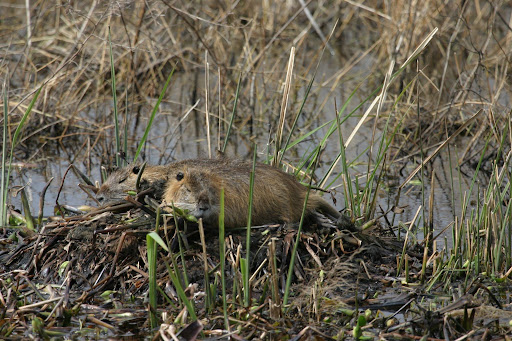
The consequences extend beyond the plants themselves. Healthy wetlands provide feeding, nesting, nursery, and shelter habitat for fish, waterfowl, amphibians, reptiles, mammals, and other wildlife. As vegetation disappears and marsh structure changes, the habitat available to these species disappears with it.
Nutria damage can also make wetland restoration more difficult. Newly planted vegetation may be consumed before it becomes established, while damaged soils and continuing erosion can make natural recovery challenging. These impacts are particularly concerning in coastal marshes already experiencing other pressures such as land subsidence and sea-level rise (U.S. Fish and Wildlife Service, 2022).
Agriculture, Shorelines, and Infrastructure
Nutria impacts are not limited to natural wetlands. In agricultural landscapes, they feed on crops including rice and sugarcane as well as corn, wheat, alfalfa, beets, peanuts, and melons (USDA APHIS, 2025).
Their burrowing creates another set of problems. Nutria excavate dens in streambanks, canals, levees, dikes, and other earthen structures. Some burrows may extend as much as 150 feet. Over time, this activity can destabilize banks, increase erosion, damage irrigation systems, and weaken infrastructure including flood-control levees, reservoir dams, roads, and building foundations (USDA APHIS, 2025).
In places such as coastal Louisiana, where healthy marshes and functioning water-control infrastructure are both important for communities, the ecological and economic impacts of nutria can therefore become closely connected.
Human and Animal Health
Nutria can also carry pathogens and parasites of concern to people, pets, and livestock. USDA APHIS identifies nutria as potential carriers of diseases and notes that their feces and urine may contain nematodes, blood flukes, tapeworms, and liver flukes that can contaminate water (USDA APHIS, 2025).
As with other wildlife, people should avoid handling nutria or coming into contact with their waste and should follow guidance from local wildlife authorities when dealing with suspected nutria.
Managing Nutria
Managing established nutria populations can be difficult. Their rapid reproduction, ability to disperse through interconnected waterways, and use of dense wetland vegetation can make individuals difficult to find and remove.
Depending on the location and management objective, nutria programs may incorporate population monitoring, trapping and removal, habitat management, public reporting, and long-term surveillance. Where eradication is the goal, detecting the final few animals can be one of the most challenging parts of the process.
One of North America’s most ambitious nutria management efforts demonstrates that eradication is possible.
A Nutria Eradication Success Story
By the late twentieth century, nutria had become a major threat to Chesapeake Bay marshes on the Delmarva Peninsula. Blackwater National Wildlife Refuge in Maryland was particularly hard hit. More than 5,000 acres of wetlands were lost there through the combined effects of nutria damage, sea-level rise, and land subsidence (U.S. Fish and Wildlife Service, 2022).
In response, the U.S. Fish and Wildlife Service, USDA Wildlife Services, Maryland Department of Natural Resources, private landowners, and numerous other partners launched what became a decades-long eradication effort. Approximately 14,000 nutria were removed, half of them from private lands. More than 700 landowners participated, helping the program protect over 250,000 acres of marsh on the Delmarva Peninsula (U.S. Fish and Wildlife Service, 2022).
Removing nutria was only part of the challenge. Managers also needed confidence that animals were no longer present. The project combined traditional trapping and wildlife surveys with tools such as remote cameras and specially trained detector dogs capable of finding nutria scat in expansive wetland landscapes. The last known nutria in Maryland was captured in 2015, followed by years of intensive monitoring to verify that the population had truly been eliminated.
In 2022, after more than two decades of work, partners officially announced that Maryland was nutria-free (U.S. Fish and Wildlife Service, 2022).
The work did not end there. With nutria expanding in neighboring Virginia, managers are now working to detect and remove animals before populations can become established farther north. Virginia biologists are using detection platforms, trapping, public reports, and even a nutria detection dog to locate animals along waterways such as the Chickahominy River (Virginia Department of Wildlife Resources, 2021).
How You Can Help
Whether you’re a landowner, outdoor enthusiast, or conservation professional, you can play an important role in detecting nutria, particularly in places where populations are new or expanding.
- Learn to identify nutria. Pay particular attention to their orange incisors, white whiskers, and long, round tail to distinguish them from native beavers and muskrats.
- Report suspected sightings. Reporting options differ by state, so contact your state wildlife or invasive species agency when you encounter a suspected nutria, especially in an area where they are uncommon or not known to occur. Photographs can help wildlife professionals confirm identification.
- Do not move or release non-native animals. Follow the principles of Don’t Let It Loose and never release unwanted animals into the environment.
- Support wetland conservation and invasive species management. Early detection, coordinated management, and restoration can help protect wetlands from nutria and other invasive species.
Nutria demonstrate how a species introduced for one economic purpose can have ecological consequences that persist for generations. They also show what sustained collaboration can accomplish. Maryland’s eradication took more than two decades, the cooperation of hundreds of landowners, and long-term commitment from multiple agencies, but ultimately removed a destructive invasive mammal from hundreds of thousands of acres of vulnerable wetland habitat.
Protecting remaining wetlands means applying those lessons elsewhere: detecting new populations early, responding before they become widespread, and working across property and jurisdictional boundaries to keep healthy wetlands intact.
References
- Evans, J. (1970). About nutria and their control. U.S. Department of the Interior, Bureau of Sport Fisheries and Wildlife.
- Louisiana Department of Wildlife and Fisheries. (n.d.). Nutria (Myocastor coypus).
- U.S. Department of Agriculture, Animal and Plant Health Inspection Service. (2025). Operational Activities: Nutria.
- U.S. Fish and Wildlife Service. (2022, September 16). Decades-long partnership eradicates destructive nutria rodents from Maryland.
- U.S. Geological Survey. (n.d.). Nutria (Myocastor coypus) species profile. Nonindigenous Aquatic Species Database.
- U.S. Geological Survey. (n.d.). Nutria (Myocastor coypus) point distribution map. Nonindigenous Aquatic Species Database.
- Virginia Department of Wildlife Resources. (2021, October 19). Messina, R. Menace of the Marsh: How Nutria Threaten Virginia’s Wetlands.
- Virginia Department of Wildlife Resources. (n.d.). Nutria.