Deep within the wetlands of southern Florida, one of the world’s largest snakes is quietly transforming an entire ecosystem. The Burmese python, a powerful constrictor native to Southeast Asia, has become one of the most challenging invasive species to manage in the United States. With an enormous appetite, remarkable camouflage, and few natural predators as adults, these snakes have established themselves throughout the Greater Everglades, where they threaten native wildlife and disrupt ecological relationships.
Originally introduced through the exotic pet trade, Burmese pythons are now the focus of extensive research and coordinated removal efforts. From tracking snakes with radio transmitters to developing new tools that identify the most effective removal strategies, scientists and wildlife managers are working to better understand and control this elusive predator.
What Is a Burmese Python?
The Burmese python (Python bivittatus) is a large, nonvenomous constrictor native to tropical and subtropical regions of Southeast Asia. Its natural habitats include forests, grasslands, marshes, and wetlands, where it feeds on a wide variety of animals.
Burmese pythons are among the largest snakes in the world, commonly reaching lengths of 10–16 feet as adults, with some individuals growing even larger. Their tan or yellowish-brown bodies feature distinctive dark blotches outlined in black, providing excellent camouflage among vegetation and forest debris.
Several biological characteristics make Burmese pythons particularly successful in southern Florida:
- Generalist predators: They consume a wide variety of mammals, birds, and reptiles, allowing them to exploit different food sources.
- High reproductive potential: Females can produce large clutches of eggs, sometimes exceeding 100 or more in a single reproductive event.
- Excellent camouflage: Their patterned bodies and secretive behavior make them extremely difficult to detect, even when populations are well established.
- Adaptability: They can occupy both terrestrial and aquatic habitats and are strong swimmers capable of moving through extensive wetland systems.
Unlike venomous snakes, Burmese pythons kill their prey through constriction, wrapping around an animal and restricting its circulation before swallowing it whole.
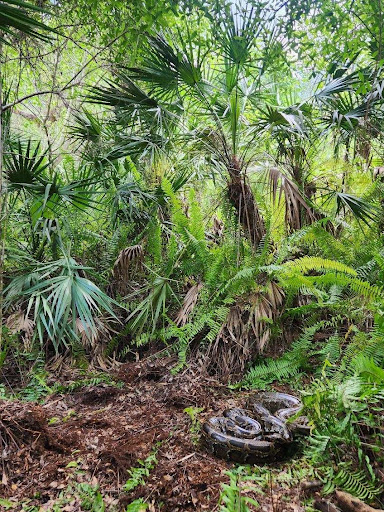
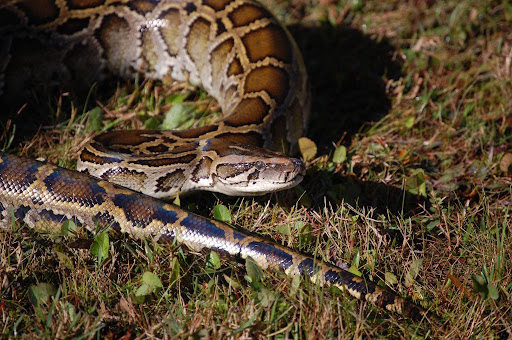
Their combination of large body size, reproductive capacity, and ability to remain hidden makes them a formidable invasive predator. Learn more about their biology in the Florida Fish and Wildlife Conservation Commission’s Burmese python species profile.
How Did Burmese Pythons Become Established in Florida?
The introduction of Burmese pythons to the United States is closely tied to the exotic pet trade.
Between 1975 and 2018, more than 180,000 Burmese pythons were imported into the United States through the live animal trade, according to the U.S. Fish and Wildlife Service (USFWS). Although many remained in captivity, some escaped or were intentionally released into the wild.
Burmese pythons can grow rapidly and require specialized housing, food, and long-term care. Unfortunately, individuals unprepared for the responsibilities of owning such a large reptile sometimes release unwanted pets into natural environments.
Research suggests that Burmese pythons had become established in southern Florida by the 1980s (Willson et al., 2011). The region’s warm climate, extensive wetlands, and abundant prey provided favorable conditions for their survival and reproduction.
Today, breeding populations are established across much of the Greater Everglades ecosystem, including Everglades National Park and Big Cypress National Preserve.
Although Burmese pythons have occasionally been documented outside this region, southern Florida remains the center of their established invasive population in the United States (EDDMapS Distribution Map).
Their history provides a powerful example of how the release or escape of non-native pets can have lasting ecological consequences.
The Ecological Impacts of Burmese Pythons
The spread of Burmese pythons has been associated with dramatic changes in wildlife populations throughout the Everglades.
One of the most widely cited studies, published in Proceedings of the National Academy of Sciences, documented severe declines in observations of several mammal species along roads surveyed in Everglades National Park. Researchers reported declines of 99.3% in raccoon observations, 98.9% in opossum observations, and 87.5% in bobcat observations (Dorcas et al., 2012).
The study also found that rabbits were no longer detected during later surveys in areas where they had previously been observed.
These declines coincided with the proliferation of Burmese pythons and were particularly pronounced in areas where the snakes had been established the longest.
While the study documented changes in wildlife observations rather than directly measuring total population sizes, its findings provided compelling evidence of the ecological disruption associated with python establishment.
A Predator With a Broad Appetite
Burmese pythons consume an extraordinary variety of prey, including small mammals, wading birds, turtles, and even American alligators.
Their ability to consume animals across different sizes and ecological groups means their impacts can extend throughout the food web. By reducing prey populations, Burmese pythons may also affect native predators that depend on the same food sources.
The consequences are particularly concerning in the Everglades, a globally significant wetland ecosystem that supports numerous threatened and endangered species.
Researchers are continuing to investigate how python predation influences food webs, wildlife communities, and the long-term ecological health of the region.
Why Are Burmese Pythons So Difficult to Manage?
Despite their enormous size, Burmese pythons are surprisingly difficult to find.
Their cryptic coloration allows them to blend into dense vegetation, while their secretive behavior and use of remote wetlands make conventional wildlife surveys challenging. Research examining detection probabilities has demonstrated just how difficult it can be to locate these snakes, even during targeted surveys (Nafus et al., 2020).
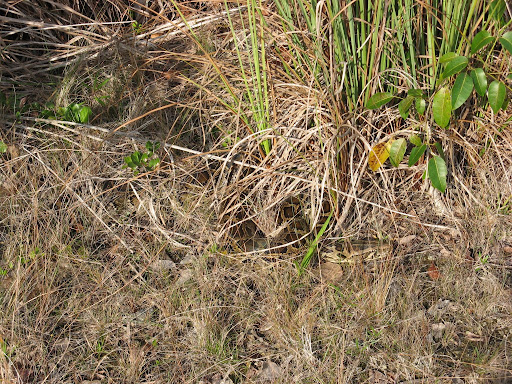
Scientists still lack a reliable estimate of the total number of Burmese pythons living in the Greater Everglades.
This uncertainty creates a major challenge for wildlife managers. Without knowing how many snakes are present, where they occur, or how quickly their populations are growing, it is difficult to determine whether removal programs are reducing the overall population.
Researchers are working to address these knowledge gaps through innovative monitoring techniques, population modeling, and studies of python biology.
Tracking Pythons From the Ground and the Air
The U.S. Geological Survey (USGS), working with the University of Florida, National Park Service, and other partners, is conducting extensive research to better understand Burmese python survival, reproduction, movement, and population dynamics.
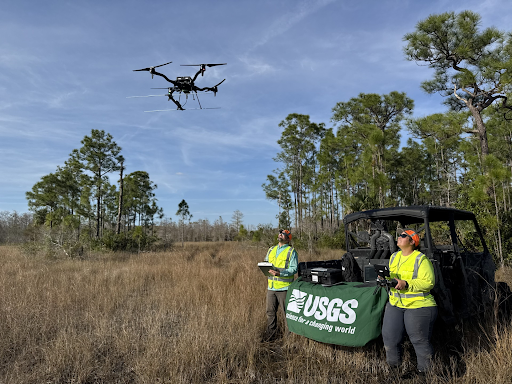
One important technique involves fitting selected pythons with radio transmitters. These tracked individuals, sometimes called scout snakes, allow researchers to monitor movements and locate other pythons, particularly during the breeding season.
Scientists are also testing radio-tracking technology mounted on small uncrewed aircraft systems, or drones, to locate tagged snakes more efficiently in difficult terrain.
By combining field observations with biological information such as growth rates, reproductive output, and survival, researchers hope to develop more effective approaches for reducing python populations.
A New Approach: Making Python Removals Count
A 2026 study led by University of Florida researchers offers a promising new way to evaluate Burmese python removal efforts.
Published in Ecological Applications, the study introduces a Weighted Removal Index (WRI), which considers the potential contribution of individual snakes to future population growth (Romer et al., 2026).
Rather than measuring management success solely by the number or total length of snakes removed, the index incorporates biological characteristics related to survival and reproductive potential.
For example, removing a large, reproductively mature female may have a greater long-term effect on population growth than removing a newly hatched python.
The researchers combined this demographic approach with machine-learning models to examine how environmental conditions and removal strategies influence outcomes.
Their findings suggest that factors such as temperature, humidity, lunar phase, and the use of assisted surveys can influence the potential population-level value of removals.
Importantly, the research also revealed that winter removal efforts may contribute disproportionately to reducing future population growth, even when fewer snakes are captured.
This approach could help wildlife managers make more informed decisions about when and how to direct limited removal resources.
Although additional research is needed to evaluate long-term population responses, the study demonstrates how advances in ecological modeling can improve invasive species management.
Working Together to Control Burmese Pythons
Managing Burmese pythons requires a coordinated approach involving federal and state agencies, researchers, professional removal contractors, and members of the public.
Because the snakes are so difficult to detect and remove, no single method has proven sufficient to eliminate established populations across the Greater Everglades.
Instead, wildlife managers are exploring a combination of strategies, including:
- Targeted removal programs: Trained personnel locate and remove pythons from priority management areas.
- Radio telemetry: Tagged snakes help researchers locate other individuals and breeding aggregations.
- Detection dogs: Specially trained dogs can help locate concealed pythons.
- Environmental DNA (eDNA): Water samples can be analyzed for genetic traces that may indicate python presence.
- Population modeling: Biological and removal data help researchers evaluate management effectiveness and prioritize future efforts.
These approaches are described in the USFWS case study, Managing Non-Native Burmese Pythons in Southern Florida, which highlights the importance of collaboration and science-based management.

The Florida Python Challenge®
One of the most recognizable public engagement efforts is the Florida Python Challenge®, an annual competition organized by the Florida Fish and Wildlife Conservation Commission (FWC) and partners.
The event encourages participants to help remove invasive Burmese pythons while increasing awareness of their ecological impacts.
Participants receive training and must follow established rules and humane removal requirements. The event also creates opportunities to collect information that can support ongoing research and management.

Although removing individual snakes is important, the larger challenge remains reducing established populations over time.
The Florida Python Challenge® illustrates how public participation can complement professional removal programs and broader conservation efforts.
How You Can Help Prevent the Spread of Invasive Species
The Burmese python’s establishment in Florida demonstrates why preventing the introduction of non-native species is so important. While researchers and wildlife managers continue working to control established populations, everyone can play a role in preventing future introductions.
Never release unwanted pets into the wild. The Don’t Let It Loose campaign encourages responsible pet ownership and helps raise awareness about the ecological consequences of releasing non-native animals. Whether you own a reptile, aquarium fish, or another exotic pet, explore responsible rehoming options if you can no longer provide proper care.
Take advantage of pet surrender programs. In Florida, the Exotic Pet Amnesty Program provides a free, legal way for owners to surrender non-native pets they can no longer care for, without penalties. The program helps place surrendered animals with qualified adopters rather than allowing them to be released into the environment. Similar rehoming resources may be available in other states and provinces.
Report invasive species sightings. Early detection is essential for preventing new populations from becoming established. In Florida, the I’veGot1 reporting system allows residents and visitors to report Burmese pythons and other non-native wildlife. Elsewhere, contact your local invasive species council, wildlife agency, or appropriate reporting program to document suspected invasive species.
Support invasive species management efforts. Programs such as the Florida Python Challenge® demonstrate how public participation can complement professional removal efforts, advance research, and raise awareness about the impacts of invasive species.
References and Additional Resources
Dorcas, M. E., et al. (2012). Severe mammal declines coincide with proliferation of invasive Burmese pythons in Everglades National Park. Proceedings of the National Academy of Sciences, 109(7), 2418–2422.
Florida Fish and Wildlife Conservation Commission. Burmese Python Species Profile.
Florida Fish and Wildlife Conservation Commission. Exotic Pet Amnesty Program.
Florida Fish and Wildlife Conservation Commission. Florida Python Challenge.
Harvey, R. G., Brien, M. L., Cherkiss, M. S., et al. (2016). Burmese Pythons in South Florida: Scientific Support for Invasive Species Management. University of Florida IFAS Extension, WEC242.
Nafus, M. G., Mazzotti, F. J., & Reed, R. N. (2020). Estimating detection probability for Burmese pythons with few detections and zero recaptures. Journal of Herpetology, 54(1), 24–30.
Romer, A. S., et al. (2026). Prioritizing removals of a highly cryptic invasive species using machine learning and demographic weighting. Ecological Applications, 36(6), e70317.
U.S. Fish and Wildlife Service. Velasco, D., Hernandez, M., & Miner, K. A. (2022). Managing Non-Native Burmese Pythons in Southern Florida. Conservation and Adaptation Resources Toolbox.
U.S. Geological Survey. (2025). Invasive Burmese python research in the Greater Everglades.
Willson, J. D., Dorcas, M. E., & Snow, R. W. (2011). Identifying plausible scenarios for the establishment of invasive Burmese pythons (Python molurus) in Southern Florida. Biological Invasions, 13, 1493–1504.